
A Song for Grandparents: Build a Family Time Capsule
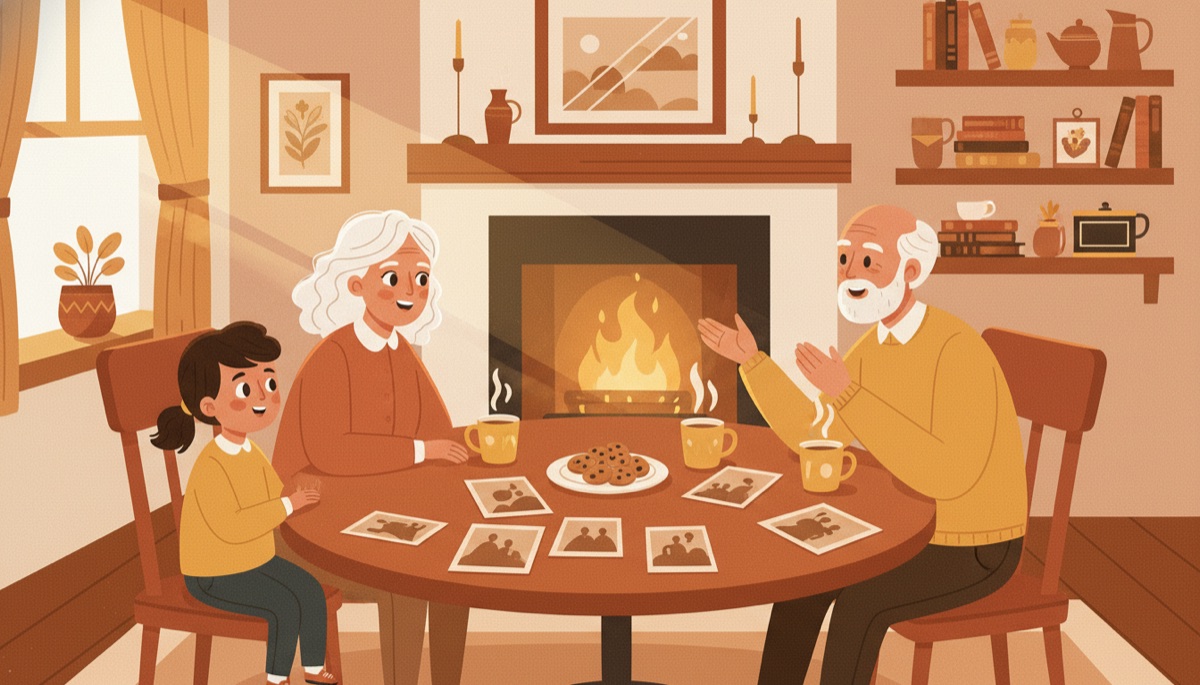
Grandparents are impossible to shop for, and it's not because they're picky. It's the opposite. They already own the sweater. The good china has been sitting untouched in the cabinet since some anniversary nobody remembers. Suggest a new phone and Grandma waves you off — "what do I need that for, I can barely work this one." Spend real money and they'll fret that you spent it on them. Buy something safe and it disappears into the drawer with all the other safe gifts. So every year, a week before the birthday, you hit the same dead end: what do you get someone who has everything they want and wants nothing you can buy?
There's an angle that changes the whole question, though. Stop asking what do I give them and ask instead: what part of them is worth saving — while there's still someone to ask? Grandpa's voice. The story about how he drove cross-country with two hundred dollars and a borrowed car to start over. The song he always hums after the second cup of coffee. All of it feels permanent, and all of it is balanced on one person. A song can hold that. And the moment it does, it stops being a gift for one evening and becomes something the whole family keeps.
A gift to them, a treasure for everyone
An ordinary present has one recipient: you buy it, you hand it over, it's done. A song for grandparents works differently, because it has two audiences at once. Today, the people listening are them, and for them it's about attention — their grandkid remembers, their grandkid noticed, their grandkid saw them clearly enough to write it down. Tomorrow, the people listening are the younger ones, and for them it's something else entirely.
Think about what you actually know about your own great-grandparents. Probably scraps: a couple of names, one half-remembered story, a faded photo where you can't quite make out the faces. And yet they were once as alive and present as your grandparents are right now. Nobody got around to recording any of it, so it simply dissolved.
A song closes that gap before it opens. It doesn't only delight an older person today — it deposits into the family record the thing that would otherwise vanish in a generation. Its value doesn't end when the last note fades. That's where it begins.
What's actually worth saving
"Archive" sounds like a museum, but in practice it's the small, living stuff — the things you notice every single time and have never once written down. Here's what nearly every family has sitting right on the surface, held up by nobody but Grandma and Grandpa:
- Their sayings. "Sit down and eat something for once." "Now don't go making a fuss." These phrases have echoed off their kitchen walls for decades — and they leave with the kitchen if nobody catches them.
- The young years. Where they met — a church dance, a factory floor, a friend's wedding. Where they came from and what they carried. What they lived through and won't talk about. None of it is in any document anywhere.
- Recipes and hands. The pie nobody else can get right. The way Grandpa could fix anything on the porch and taught you without a word, just by handing you the wrench. The thing their hands knew how to do.
- The sound of the house. The radio on the windowsill, the tune Grandpa starts at the table after dinner, the exact way Grandma calls you in from the yard. A pitch of voice you could pick out of a thousand.
You don't need to collect all of it. A handful of things that catch in your own throat is plenty.
Why a song, and not a photo album or a video
There's more than one way to hold onto family memory, and you've probably tried a few. A photo is mute: it shows you a face and tells you nothing about the person. Video gets closer, but put Grandma in front of a camera and she goes stiff, talks in a voice that isn't hers, calls everyone by their full name. And the "sit down and tell us about your life" recording? Almost nobody finishes it. It's long, it's awkward, the camera light is hot, and the tape ends up half-done in a drawer.
A song dissolves that awkwardness. Grandma doesn't have to perform for a lens — the melody and the singer do that part for her. What goes inside is the real thing: a phrase, a story, the recipe, the dance where she met Grandpa. The result isn't a dry record. It's something you actually want to press play on, which is exactly why it gets played again.
And here's what the album in the closet can't do: a song lives out in the open. It goes on at the anniversary dinner. It gets sent to the cousins. Someone puts it on when they miss him. An archive that gathers dust eventually gets lost in a move. The one that plays at the table passes itself down without anyone trying.
How to gather the capsule while there's someone to ask
The best material for a song like this isn't in your head — it's in their memory, and the only way to get it out is to ask. That's the hidden bonus of the whole project: you finally sit down and ask the questions, while there's still someone who knows the answers.
So sit with them over coffee and pull on a thread. "Grandma, how did you and Grandpa really meet — the honest version, not the one for company." "Grandpa, is it true you actually...?" Questions like that shake loose things you've never heard in your life: the name of his first dog, the song the band played at their wedding, what the apartment cost when it was all they could afford. Write it down — on your phone, on a napkin, wherever.
From the conversation, pick five to eight things that land hardest. Put the two strongest in the chorus, where they act as an anchor the listener keeps coming back to. Thread the rest through the verses. Don't go past that. A song that tries to hold an entire biography turns into a rhymed questionnaire — names and dates with no air in them. A few exact details, said in their own words, is the capsule. That's the whole trick.
Common mistakes
- Greeting-card cliches. "Heart of gold," "always there for me," "the rock of our family." Let one of these slip in and the song stops being about your grandmother and starts being about anybody's. A time capsule only matters if this specific person is inside it — not a generic portrait of a nice grandparent.
- A pile of adjectives. "Kind, wise, loving, caring, strong." That's what you write when you didn't ask and have nothing concrete to say. Replace every adjective with the actual thing they did or said. Not "she was generous" — "she'd send you home with the leftovers and pretend she'd cooked too much on purpose."
- Putting it off. The big one. "I'll get around to it, I'll ask her next year." Next year is not promised. You build the capsule while there's someone to ask; the perfect moment never arrives, so the slightly-too-early one is the right one.
- Making it about your taste. Your favorite genre is a gift to yourself. Reach for the music of their youth instead — the crooners, the old country tune, the church hymn, whatever Grandpa always hums at the table. The frame should sound like the time they were young in.
- Hiding the recording "for a special occasion." A song you keep on your phone and never play to anyone disappears the day that phone does. Let everyone hear it. Send it to the cousins. An archive only survives if it's used — so use it loudly.
Frequently asked questions
The detail only they would know.
A personalized song with a free 1-minute preview before you pay.
▶ Create a Song